AI visual testing in 2026: what the AI actually does
AI visual testing means two different things: AI-powered diffing and AI-assisted review. Learn how each works, where AI helps, and what to trust.

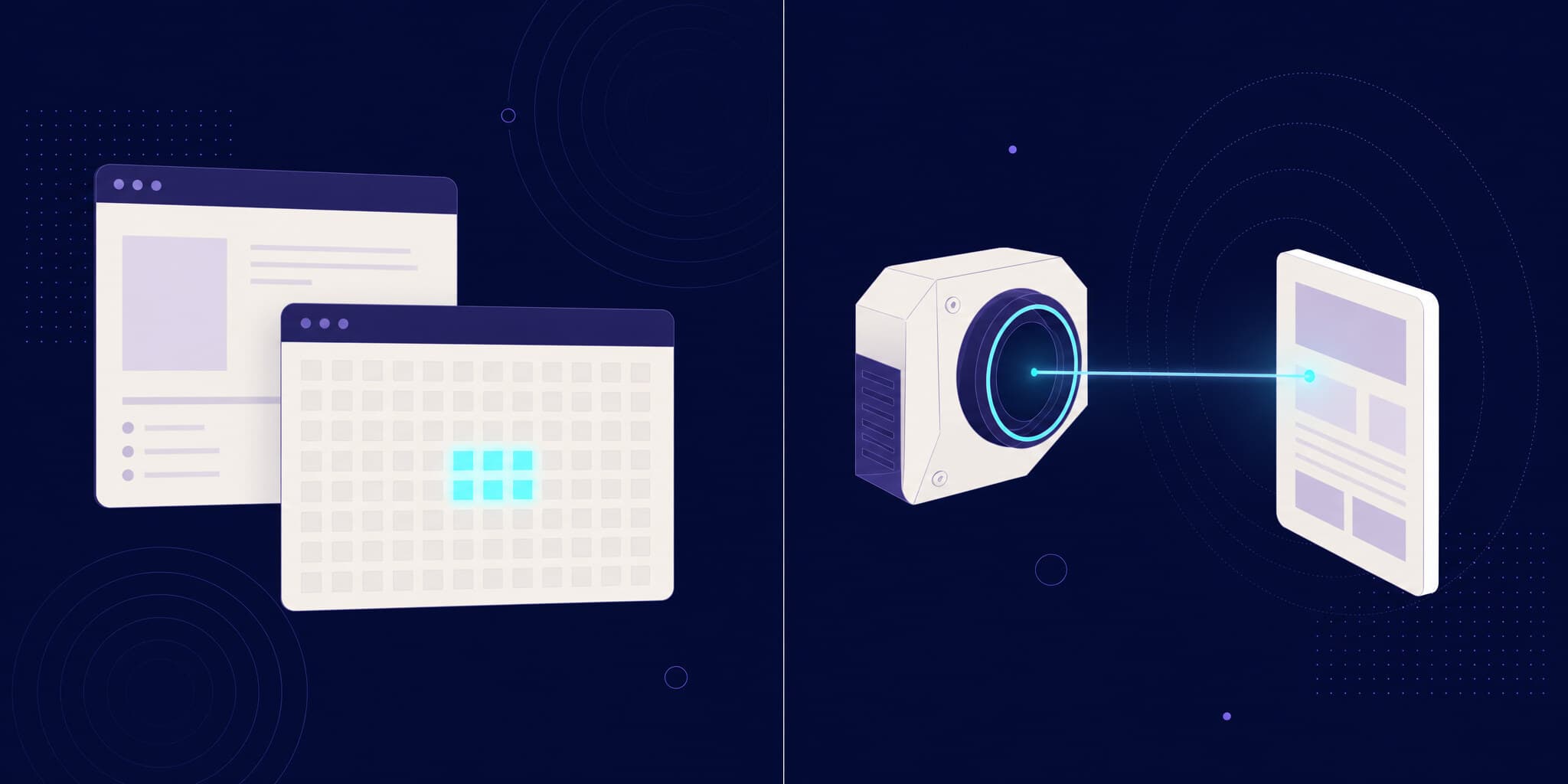
"AI visual testing" is two different products wearing the same label. The first is AI-powered diffing: a model decides which pixel differences are "meaningful" and hides the rest. The second is AI-assisted review: the comparison stays deterministic and pixel-accurate, and an AI agent reasons about the resulting diffs in the context of your pull request. In 2026, nearly every vendor claims "AI", so the useful question is not "does this tool have AI?" but "which of the two jobs is the AI doing, and can I still trust exactly what changed?"
Why every visual testing tool suddenly has "AI"
Between 2025 and 2026, the whole category rebranded. Applitools has marketed its comparison engine as Visual AI for years. Percy (BrowserStack) shipped an AI "Visual Review Agent" in October 2025, and the BrowserStack MCP server exposes Percy tools to agents. Applitools published an Eyes MCP server in March 2026, and Chromatic released Storybook MCP servers the same month. Argos shipped an agent-ready CLI and API with open-source agent skills.
These are not the same feature. Some of that AI runs inside the comparison, changing what counts as a difference. Some of it runs on top of the comparison, changing who reviews the differences. Conflating the two is how teams end up surprised by what their tool silently ignored.
What are the two kinds of AI in visual testing?
1. AI-powered diffing: the model decides what changed
This is the Applitools pitch, and it is a real technology. Instead of comparing screenshots pixel by pixel, a computer-vision model classifies differences: anti-aliasing artifacts, sub-pixel font rendering shifts, and cursor blinks get ignored; layout moves and content changes get flagged. The promise is fewer false positives without you tuning anything.
The trade-off is that the comparison becomes a black box. When the model says "no meaningful change," you cannot inspect a rule or a threshold to understand why. When it misclassifies, a real one-pixel regression dismissed as noise, or noise flagged as a regression, you cannot reproduce or debug the decision. You retrain your trust in a vendor's model instead of your own eyes. And it is priced accordingly: Applitools Starter is $667/month, paid annually, and the larger plans are quoted by sales. See our full Argos vs Applitools comparison.
2. AI-assisted review: the agent reasons about deterministic diffs
The second kind keeps the comparison boring on purpose. The diff engine stays deterministic: same two screenshots in, same diff out, every time. The AI sits one layer up, doing what a human reviewer does: it reads the pull request title, description, and code changes, looks at each flagged diff, and judges whether the visual change matches the intent of the PR.
This is the architecture Argos bets on. Comparisons are pixel-accurate and reproducible, and an agent inspects builds through structured CLI output:
# Fetch build status and stats as JSON
npx @argos-ci/cli build get <buildRef> --json

# Fetch only the diffs that need a decision
npx @argos-ci/cli build snapshots <buildRef> --needs-review --json

# Submit a review conclusion
npx @argos-ci/cli review create <buildRef> --event approve
Open-source skills teach the agent the whole workflow (npx skills add argos-ci/argos-javascript@argos-pr-review), and a Copy prompt button in the build UI generates an agent-optimized prompt for any assistant. We wrote a full walkthrough in reviewing Argos builds with AI agents, and a broader piece on how AI coding agents change visual testing.
The division of labor matters: the deterministic diff is the evidence, and the agent is the reviewer. If the agent gets it wrong, you can look at the exact same diff it looked at and overrule it. Nothing was hidden before it reached you.
Why do deterministic diffs beat black-box AI diffing?
Three properties you give up when a model decides what changed, and why they matter:
- Reproducibility. A deterministic comparison produces the same result on every run and every re-run. That makes CI results stable, bisectable, and arguable: when a teammate asks "why did this build fail?", the answer is a specific diff image, not a model score. AI-diffing verdicts can shift as the vendor updates the model, which means a passing baseline can start failing (or worse, stop failing) with zero changes on your side.
- Debuggability. When a deterministic diff flags noise, the fix is inspectable: stabilize the page, or raise a threshold on that one screenshot. When an AI diff misjudges, your only lever is "mark it and hope the model learns."
- Auditability of misses. The scariest failure mode in visual testing is the silent false negative. A pixel-accurate engine physically cannot hide a change from you; it can only flag too much, which is annoying but visible. An AI engine tuned to suppress noise can suppress a real regression, and you will never see the evidence.
The standard objection is that pixel-perfect diffing drowns you in false positives. That was true for naive screenshot comparison. It is not true for a modern deterministic pipeline, which attacks noise at the source instead of filtering it after the fact:
- Stabilization before capture. Argos SDKs wait for fonts, images, and network idle, and hide carets and scrollbars before taking the screenshot. Most "flaky diffs" are actually unstable captures; details in screenshot stabilization.
- Capture in your real test browser. Screenshots are taken locally in the browser your Playwright or Cypress tests already run, not re-rendered in a separate cloud environment. One less rendering pipeline, one less source of unexplained differences.
- Per-screenshot sensitivity thresholds. For the noisy cases that remain (canvas, charts, media), you loosen tolerance on that one screenshot, explicitly and visibly, instead of loosening trust in the entire suite.
- Flaky detection signals. Argos surfaces flake indicators so you can fix root causes rather than mask them. Our guide to fixing flaky visual tests covers the playbook.
With noise handled deterministically, there is very little left for an AI diffing engine to clean up, and everything left is something you want to see.
When does AI-powered diffing help?
One concession: if you have a large legacy suite you cannot stabilize, hundreds of screenshots across environments you do not control, riddled with anti-aliasing differences and rendering drift, an AI comparison engine like Applitools Visual AI will cut through that noise faster than you can refactor it. Large enterprises with cross-platform matrices and dedicated QA budgets are exactly who it was built for, and it is strong there.
But that is a workaround for uncontrolled capture, not a superior architecture. If you are building your visual testing setup today, on Playwright, Cypress, or Storybook, in CI you control, stabilized capture plus deterministic diffing gives you the low-noise outcome and keeps every decision inspectable, at a fraction of the price.
How do the main tools compare on AI?
As of September 2026:
| Tool | What "AI" means there | Comparison engine | Entry pricing |
|---|---|---|---|
| Argos | Agents review deterministic diffs via CLI/API, open-source skills | Deterministic, pixel-accurate, per-screenshot thresholds | Free 5k/mo, then $100/mo flat |
| Chromatic | Storybook MCP servers (Mar 2026) | Deterministic (their cloud, SteadySnap anti-flake) | From $179/mo |
| Applitools | Visual AI comparison engine ignores noise, flags "meaningful" diffs | AI-powered (black box) | From $667/mo, billed annually |
| Percy | Visual Review Agent (Oct 2025), MCP tools via BrowserStack | Pixel comparison with AI noise reduction, on cloud renders | Paid plans not published |
Two things stand out. First, most of the market's "AI" is review-layer AI on top of pixel comparison; Applitools goes furthest in putting a model inside the diff itself, and Percy markets AI noise reduction in its engine. Second, the AI label has no correlation with price: Argos gives you the agent-review layer, deterministic diffs, and unlimited parallelization at $100/month flat, and it is open source.
What should you actually look for in an AI visual testing tool?
Skip the label and ask four questions:
- Is the comparison reproducible? Same inputs should always produce the same diff. If not, your CI signal degrades over time in ways you cannot audit.
- Can an agent read the results programmatically? JSON output from a CLI or REST API, not just a web dashboard. Screenshots of dashboards are not an agent interface.
- Can an agent act with scoped permissions? In Argos, a project token grants read access to build data, while submitting a review requires a personal access token, so an agent can inspect everything but only approves as an identified user.
- Does the tool fight noise at capture time or hide it at diff time? Stabilization and per-screenshot thresholds keep you in control; model-side suppression takes control away.
If a tool answers those well, the AI on top becomes useful instead of a demo. Setting it up takes minutes; start with the getting started guide.
FAQ
What is AI visual testing?
AI visual testing is the use of AI in visual regression testing, in one of two forms: AI-powered diffing, where a computer-vision model decides which pixel differences are meaningful (Applitools Visual AI), or AI-assisted review, where deterministic diffs are evaluated by an AI agent in the context of a pull request (the Argos approach). The two solve different problems and should not be evaluated as one feature.
Is AI diffing better than pixel-based diffing?
Not for most teams in 2026. AI diffing reduces noise but makes results non-reproducible and hides its reasoning, so misclassified regressions are invisible. A deterministic pipeline with capture stabilization and per-screenshot thresholds achieves comparably low noise while keeping every decision inspectable. AI diffing earns its keep mainly on large legacy suites whose capture environment cannot be stabilized.
Can AI fully replace human review of visual changes?
No, and it should not silently do so. An agent can triage diffs, match them against PR intent, and recommend or submit a conclusion, which removes most of the grunt work. But because Argos diffs are deterministic, a human can always inspect the exact same evidence and overrule the agent. Keep the agent's review as a strong first pass, not an unreviewable verdict.
Does Argos use AI to compare screenshots?
No. Argos comparisons are deterministic and pixel-accurate, with stabilization before capture and per-screenshot sensitivity thresholds to control noise. The AI layer sits on top: agents inspect builds and submit reviews through the CLI and REST API, using open-source skills like argos-pr-review. You always see exactly what changed.
Conclusion
Treat "AI visual testing" as two separate purchasing decisions. For the comparison itself, you want boring, deterministic, pixel-accurate diffs, because the diff is evidence and evidence should be reproducible. For the review, AI is a real upgrade: agents that read your PR, inspect flagged diffs, and submit conclusions save real time. Applitools puts AI inside the comparison and charges enterprise prices for it; Argos keeps the comparison deterministic, kills noise with stabilization and thresholds, and gives agents a first-class interface on top, free up to 5,000 screenshots per month and $100/month flat after that. That is the version of AI visual testing you can trust and debug.